
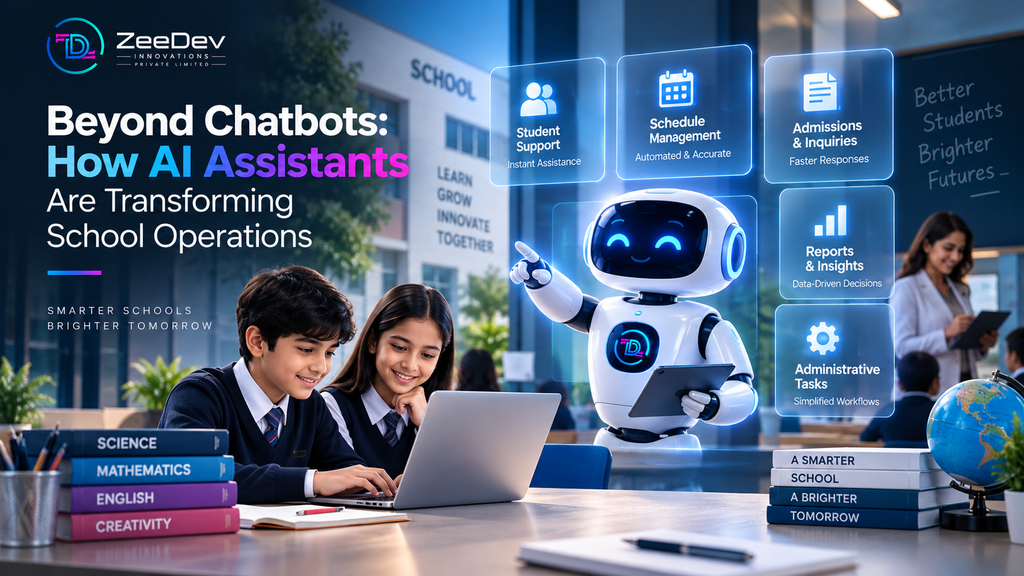
Beyond Chatbots: How AI Assistants Are Transforming School Operations
Most schools that say they’ve “adopted AI” mean one of two things. A chat widget on the admissions page that answers the same six questions badly, or teachers quietly using ChatGPT to draft worksheets at 11pm.
Neither is where the real change is happening.
The schools pulling ahead are connecting AI to the systems that actually run the school: attendance, fees, admissions, timetables, parent communication. The assistant doesn’t just answer a question. It checks the student record, notices the pattern, drafts the message, routes the exception to the right person, and logs what it did. That’s the difference between a chatbot and an assistant, and it’s the difference between a novelty and a school office that runs with half the friction.
The short answer: AI assistants are handling the repetitive, rules-based work of school operations (inquiries, absence follow-up, fee reminders, cover arrangements, routine parent questions) so that people can spend their time on the decisions that need judgement. The schools getting results start with one operational problem, connect the AI to real school data, keep humans on every consequential decision, and write the policy before rolling it out. The ones getting burned bolted a chatbot onto a website and called it a strategy.
Talk to our team about AI for your school →
Chatbot, assistant, agent: the distinction that decides whether it works
These three words get used interchangeably. They shouldn’t be, because they describe very different amounts of usefulness.
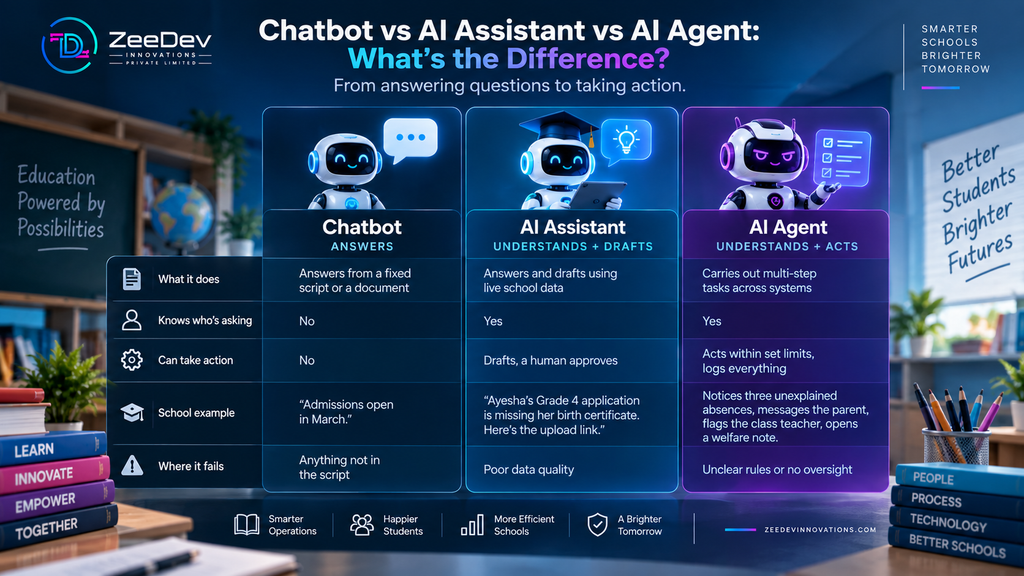
A chatbot answers questions about the school. An assistant answers questions about your child at the school. An agent does the follow-up nobody had time for.
Most schools should be building assistants now and letting a few tightly-bounded agent workflows grow out of them. Jumping straight to autonomous agents on messy data is how schools end up apologising to parents.
Where the time actually goes
The case for AI in school operations is a workload case before it’s a technology case.
Teachers in England average 50.3 hours a week according to the Department for Education’s 2024 workload survey, against a standard 37.5-hour working week. A large share of that overage is administration: data entry, parent emails, cover arrangements, report writing, compliance paperwork.
The early numbers on AI are encouraging. A Gallup and Walton Family Foundation survey found teachers who use AI at least weekly save an average of six weeks across a school year. The same research found schools with a formal AI policy see a noticeably bigger return, around 2.3 hours saved per teacher per week against 1.7 hours in schools without one. Yet only 19% of teachers said their school had a policy at all.
That gap matters. It means most of the time savings available right now are being left on the table, not because the technology doesn’t work, but because schools haven’t organised themselves to use it.
It’s not only teachers either. RAND found 58% of US principals were already using AI tools for their own work in the 2023–24 school year. Leadership adoption is running ahead of institutional planning almost everywhere.
Eight operations where AI assistants are earning their keep
1. Admissions and inquiries
Admissions season is the single biggest spike in most school offices. Hundreds of parents asking the same questions about fees, transport routes, age cutoffs, required documents, test dates, and campus locations, mostly in the evening when the office is closed.
An assistant connected to your admissions system can answer those around the clock, in English, Urdu, or the Roman Urdu most parents actually type in on WhatsApp. More usefully, it can check an application’s status, tell a parent exactly which document is missing, book a campus visit into a real calendar slot, and hand warm leads to your admissions team with the full conversation attached.
The measurable win isn’t fewer phone calls, although you’ll get those. It’s fewer lost applications. Every parent who asks a question at 10pm and gets no answer until the next afternoon is a parent who might enrol elsewhere.
2. Attendance and absence follow-up
Most schools record attendance well and act on it poorly. The data sits in a register or an SIS, and following up depends on a busy class teacher remembering.
An assistant can message parents automatically when a child is marked absent without notice, collect the reason, and file it against the record. The more valuable layer is pattern detection. Three Monday absences in five weeks. A student whose attendance has dropped from 96% to 81% over a term. A cluster of absences in one class after a particular incident. These get flagged to the right member of staff weeks before they’d surface in a report.
That early flag is where some of the best educational value in operational AI sits. The system notices in week four what a teacher might only spot in week eight.
3. Fee collection and reconciliation
For private schools, fee management consumes an enormous amount of office time. Reminders, chasing defaulters, matching bank transfers and JazzCash or Easypaisa payments to student accounts, answering “did you receive my payment?” several dozen times a week.
An assistant can send reminders on a schedule, answer balance questions from the ledger, reconcile incoming payments against challans, and produce a clean defaulter list each week instead of a spreadsheet someone assembles by hand. What it should never do is make the decision about a waiver, a payment plan, or a withheld result. Those involve families in difficulty and belong with a person.
4. Parent communication
Circulars, reminders, event notices, closure announcements. Schools in Punjab know the drill: a smog closure or a sudden weather decision, and the phones melt by 7am.
An assistant answers “is school open tomorrow?” from the official announcement rather than guesswork, drafts circulars for review, translates them, and routes genuine concerns to a human. It also gives parents one reliable place to get answers, which is often a bigger improvement than any individual feature.
A quiet benefit: consistent answers. Two parents asking the same question should get the same answer, which isn’t always true when the reply depends on which staff member picked up the phone.
5. Timetabling and substitute cover
A teacher calls in sick at 6:45am. Someone has to work out which periods are affected, who’s free, who’s qualified for that subject, who’s already covered too much this month, and message them all before assembly.
This is a constraint problem, and AI handles constraint problems well. An assistant can propose a cover plan in seconds, balanced for fairness, for a coordinator to approve with one tap. The same logic applies to building the term timetable, allocating rooms, and scheduling exams across multiple campuses without clashes.
6. Early warning for students at risk
This is where operational data meets student welfare. Attendance, assessment results, homework submission, and behaviour notes each tell part of a story. Together they tell it much earlier.
A well-built assistant surfaces the combination: attendance dipping, marks slipping, homework going missing, all in the same three weeks. It doesn’t diagnose anything. It puts a name in front of a counsellor or class teacher who can then have a conversation.
Handled well, this is one of the most valuable things AI does in a school. Handled carelessly, it becomes surveillance, which we’ll come back to.
7. Reports, records, and compliance
Report card comments, inspection documentation, board submissions, staff appraisal records, incident logs. Enormous amounts of writing, much of it structured and repetitive.
An assistant drafts from the data, and a teacher edits. Good report comments still need a teacher’s knowledge of the child, but starting from an accurate first draft grounded in actual marks and attendance is a very different job from starting from a blank box.
8. Staff attendance and HR operations
Staff attendance, leave requests, substitution records, payroll inputs, onboarding paperwork. A QR-code or app-based check-in linked to an assistant can handle leave balances, flag patterns, and feed payroll directly, eliminating the monthly reconciliation exercise most school HR teams dread.
Why “chatbot first” projects usually disappoint
We see the same pattern repeatedly. A school installs a website chatbot, parents try it a few times, it fails, and the school concludes AI “doesn’t work for us.”
It failed for predictable reasons:
It wasn’t connected to anything. It answered from a PDF uploaded eight months ago, so its fee information was wrong by the second term.
It couldn’t hand off. When a parent had an actual problem, the bot looped instead of passing the conversation to a person. Nothing destroys trust faster.
It lived in the wrong place. Parents in Pakistan communicate with schools on WhatsApp. A chat window on a website most parents visit twice a year isn’t where the conversation happens.
It spoke the wrong language. An English-only bot facing parents who type in Roman Urdu is a bot that mostly fails.
Nobody owned it. No one was responsible for its answers, reviewing its mistakes, or updating its knowledge. So it drifted.
Every one of these is a design and integration failure, not an AI failure. The fix is the same each time: connect it to the real school system, put it where parents already are, give it a clean escalation path, and assign a person to own it.
The risks are real, and they grow with use
This is the section vendor articles skip.
The Center for Democracy & Technology’s 2025 research across US schools found 85% of teachers and 86% of students had used AI tools during the 2024–25 school year. It also found that risk rises with use. Teachers who used AI for many school purposes were more likely to report their school had suffered a large-scale data breach, 28% against 18% among teachers who used it for few or none. Nearly one in five parents had been notified by their child’s school about a breach or ransomware attack.
The mechanism is straightforward. AI systems consume a lot of data and produce a lot of data. Every integration is another place student information travels, and every vendor is another party holding it.
Four rules we apply on every school project:
Humans decide anything consequential. Admissions decisions, discipline, fee waivers, grades, safeguarding, anything that shapes a child’s record. The assistant prepares, a person decides, and the log shows who.
Collect less. An assistant that answers fee questions doesn’t need medical records. Scope access narrowly per function.
Know where the data lives. Which country, which vendor, whether it’s used to train someone else’s model, how long it’s kept, and how you get it back. If a vendor can’t answer those plainly, don’t sign.
Treat children’s data as though the strictest rules apply. Regulation varies by country and is changing quickly. In the EU, AI used for admissions and assessment is already classified as high-risk under the AI Act. Whatever your local legal position, parents will hold you to the highest standard when something goes wrong.
And be honest with families about what’s automated. Parents are generally comfortable with AI handling logistics. They’re rightly uncomfortable finding out afterwards that an algorithm had a hand in something about their child.
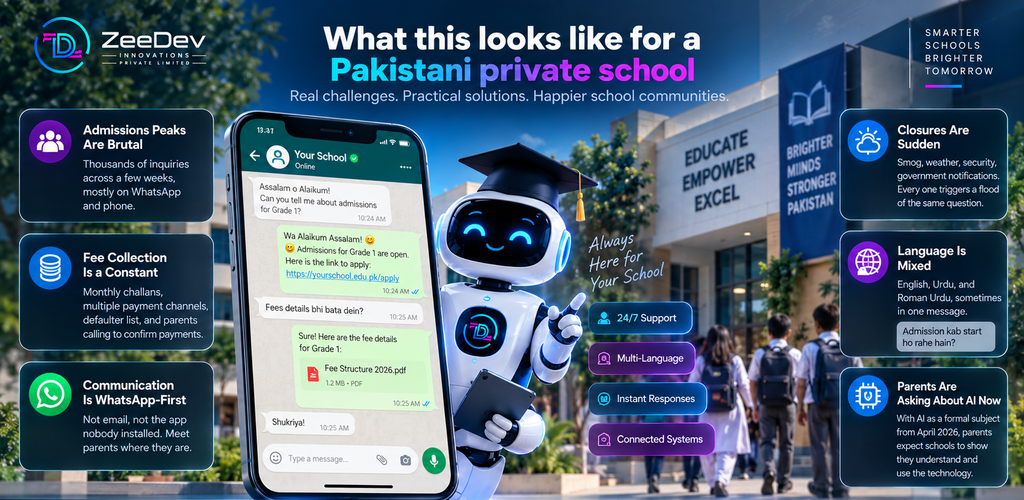
What this looks like for a Pakistani private school
Private schools educate more than a third of school-age children in Pakistan, from low-fee neighbourhood schools to large multi-campus chains. The operational pressures are specific.
Admissions peaks are brutal. A chain with six campuses might field thousands of inquiries across a few weeks, overwhelmingly on WhatsApp and phone, many outside office hours.
Fee collection is a constant. Monthly challans, multiple payment channels, a steady defaulter list, and parents calling to confirm payments.
Communication is WhatsApp-first. Not email, not the app nobody installed. Any assistant that doesn’t live on WhatsApp is working around parents rather than with them.
Language is mixed. English, Urdu, and Roman Urdu, sometimes in one message.
Closures are sudden. Smog, weather, security, government notifications. Every one triggers a flood of the same question.
Parents are asking about AI now. With Islamabad’s Federal Directorate of Education introducing AI as a formal subject from April 2026, parents increasingly expect schools to show they understand the technology. How a school uses AI in its own operations is now part of how it’s judged.
For a school like this, the first project is almost always the same: a WhatsApp-based assistant connected to the admissions and fee systems, answering in all three languages, handing off cleanly to named staff. It pays for itself in the first admissions season.
A 90-day rollout that doesn’t go wrong
Days 1–30: pick one problem and measure it. Not “adopt AI.” One problem. Admissions inquiries answered after hours, time spent chasing fee reminders, cover arrangements each morning. Record the baseline: how many, how long, how much staff time. Without a baseline you’ll never know if it worked.
Days 31–60: connect, don’t bolt on. Build or configure the assistant against your actual school system, not a document dump. Set the escalation path. Decide what it may do alone, what it drafts for approval, and what it never touches. Write the AI-use policy in parallel, including what you’ll tell parents.
Days 61–90: launch small, review weekly. One campus or one function. A named owner reads the conversation logs every week, fixes wrong answers, and tracks the baseline metric. Train the staff who’ll work alongside it, since the Gallup numbers are clear that support and policy multiply the benefit.
Then expand to the next problem. Schools that try to automate six functions at once usually automate none of them properly.
Questions to ask any vendor before you sign
- Where is our students’ data stored, and in which country?
- Is our data used to train your models or anyone else’s?
- Can we export all our data, in a usable format, if we leave?
- Does it connect to our existing SIS, or does it need its own copy of everything?
- How does escalation to a human work, and how fast?
- Does it support Urdu and Roman Urdu, and on WhatsApp?
- What’s logged, who can see the logs, and for how long are they kept?
- What does it cost at our actual volume of conversations during admissions season, not an average month?
Vague answers to any of the first three are reason enough to walk away.
Build, buy, or integrate?
Buy an off-the-shelf school management system with AI features built in if you’re a single campus with standard processes and no existing software you want to keep. Quickest route, least flexibility.
Integrate an AI assistant with the systems you already run if you have a working SIS, fee system, or attendance tool your staff know. This is the most common right answer, and it avoids migrating years of records.
Build custom when you’re a multi-campus chain with processes no product fits, when you need deep WhatsApp integration with your own data, or when data control matters enough that you want the whole stack under your roof. Higher upfront cost, full ownership, and it fits how your school actually works rather than how a vendor imagined schools work.
The honest limit
AI assistants make a functioning school run better. They don’t make a struggling school function.
Pakistan’s hardest education problems are foundational: tens of millions of children out of school, and many who are in school not reaching basic reading levels. Operational AI doesn’t touch those, and anyone who claims otherwise is selling something.
What it does is give time back to the people doing the work. The real question for school leaders isn’t whether to use AI. It’s what your staff will do with the hours it returns. If the answer is more time with students, you’re using it well.
Frequently asked questions
What is the difference between a school chatbot and an AI assistant? A chatbot answers general questions from a fixed script or document and doesn’t know who’s asking. An AI assistant connects to live school systems, so it can answer about a specific child’s application, attendance, or fee balance, draft responses for staff approval, and hand conversations to the right person.
Can AI replace school administrative staff? No, and schools shouldn’t plan on it. AI handles repetitive, rules-based work such as answering routine questions, sending reminders, reconciling payments, and drafting reports. Staff remain responsible for judgement calls, family conversations, exceptions, and every decision affecting a student’s record. The realistic outcome is the same team doing less paperwork and more meaningful work.
Is it safe to use AI with student data? It can be, with the right controls. Keep humans on consequential decisions, give each AI function access only to the data it needs, confirm where data is stored and that it isn’t used to train outside models, and keep logs. Research from the Center for Democracy & Technology found breach risk rises as schools use AI more widely, so governance should scale with adoption.
How much time can AI save teachers and school staff? A Gallup and Walton Family Foundation survey found teachers using AI weekly save around six weeks across a school year, with schools that have a formal AI policy saving roughly 2.3 hours per teacher per week against 1.7 hours without one. Office staff savings depend on which functions are automated, with admissions inquiries and fee follow-up usually showing the fastest returns.
Should a school’s AI assistant work on WhatsApp? In Pakistan and most of South Asia, yes. Parents communicate with schools overwhelmingly on WhatsApp, so an assistant confined to a website chat window misses most conversations. It should also handle English, Urdu, and Roman Urdu.
Where should a school start with AI? With one measurable operational problem, such as after-hours admissions inquiries or daily cover arrangements. Record a baseline, connect the assistant to real school data, define what it may and may not do, write the AI-use policy, then run a small pilot with weekly review before expanding.
Where we come in
ZeeDev Innovations builds custom web applications, management systems, and AI-powered tools from Islamabad for organisations in Pakistan, the UK, and the US, including QR-based attendance systems and the AI Lawyer System app. For schools, that means assistants that connect to the systems you already run, live on WhatsApp where parents already are, and answer in the languages families actually use.
See our portfolio, look at what we build, or book a free consultation and we’ll help you pick the first operational problem worth solving.