Android vs iOS vs Cross-Platform App Development: Which Is Right for Your Business?
Most people ask this question backwards. They ask which platform is better. The platform isn’t the decision. The decision is where your customers are, what your app has to do, and how much you can afford to maintain for the next five years.
Here’s the short version:
- Android first if your users are in Pakistan, India, Indonesia, Africa, or most of the emerging world. In Pakistan, iPhone share sits below 7%. An iOS-first launch here reaches almost nobody.
- iOS first if your users are in the US, UK, Japan, or Australia, or if the app makes money through subscriptions and in-app purchases. iPhone users generate roughly two-thirds of all app spending worldwide.
- Cross-platform if you need both stores on one budget, which covers most business apps. Expect to ship 30–40% cheaper and up to 50% faster than building twice.
- Native both if the app depends on camera, Bluetooth, AR, background processing, or day-one access to new OS features, and you have the budget to run two codebases.
And a fourth answer nobody selling app development wants to give you: a lot of businesses asking this question don’t need an app yet. More on that at the end, because it’s the honest starting point.
Talk to our mobile team about your project →
At a glance
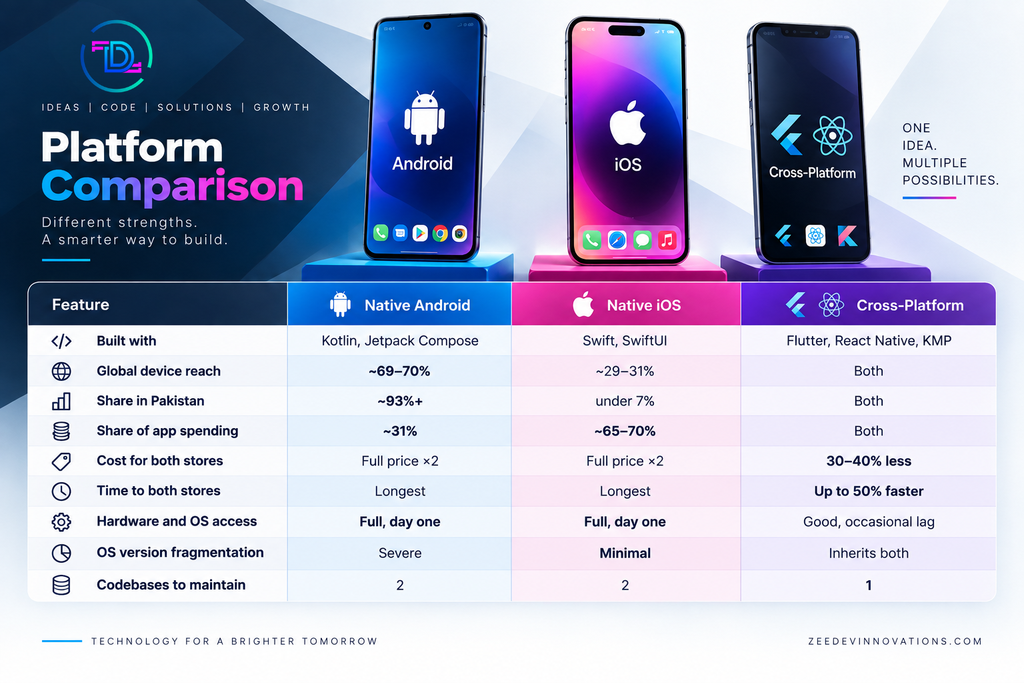
Reach and revenue point in opposite directions
This is the tension underneath the whole decision, and it’s worth getting clear before anything technical.
Android runs on roughly 69–70% of active mobile devices worldwide, iOS on about 29–31%. Google Play accounted for around 70% of global app downloads in 2025, roughly 99 billion installs against the App Store’s 40 billion.
Now flip to money. The App Store generated somewhere between $94 billion and $117 billion in consumer spending in 2025 depending on whose dataset you use, against roughly $49–65 billion on Google Play. Either way iOS captures around two-thirds of global app spending from under a third of devices. iPhone users earn more on average and pay for things more readily.
So the rule most agencies state is: Android for reach, iOS for revenue.
That rule is correct globally and misleading locally, which brings us to the part that decides most of our clients’ builds.
What this means if your users are in Pakistan
iPhone penetration in Pakistan is below 7%. Android is north of 93%, following the same pattern as India at roughly 95%, Indonesia, and Bangladesh.
If you’re building a consumer app for Pakistani users a delivery service, a marketplace, a clinic booking app, a local fintech product launching iOS first is spending most of your budget to reach a small minority of your market. Build Android first, validate, add iOS when you have users asking for it or when you start selling abroad.
The opposite holds if you’re targeting buyers in the US, where iOS runs close to 58–59% of devices, or the UK, Japan, and Australia. A Pakistani company building for US customers is building an iOS-first product, even though almost every phone in the office runs Android. We’ve seen teams get this backwards by defaulting to what they carry in their own pockets.
How we compared these
We build in Flutter, React Native, and native, and we maintain apps we shipped years ago. That second part shapes the criteria more than the first.
Anyone can compare frameworks on a feature table. What actually hurts on real projects is the stuff that shows up in year two: the cost of running two codebases when one developer leaves, a native SDK that has no plugin for your framework, an OS release that breaks something, a store review that holds up a fix for a week. So the criteria below weight maintenance and total cost over launch-day convenience.
Head to head
Cost and time
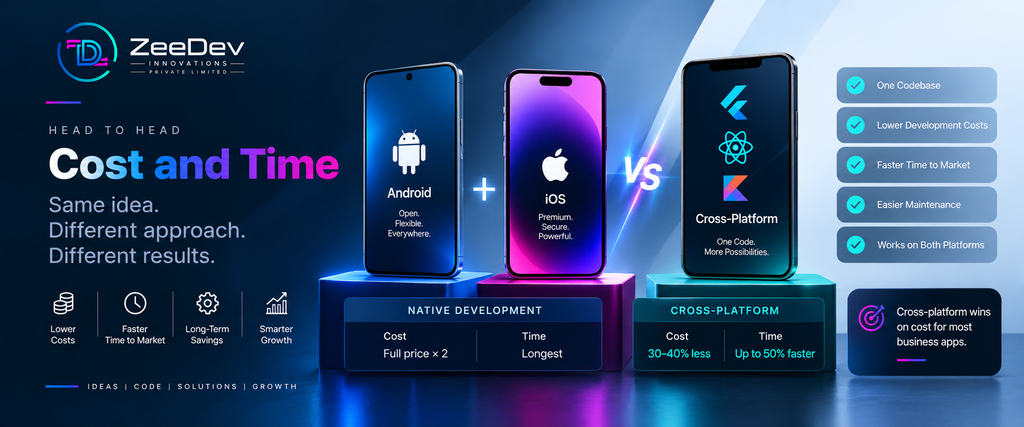
Building native for both platforms means two codebases, two skill sets, two sets of bugs, and two deployment pipelines. For a typical business app, cross-platform ships both stores roughly 30–40% cheaper and as much as 50% faster.
That gap isn’t a one-time saving. It repeats every time you add a feature, for as long as the app exists. Over three years, the maintenance difference usually exceeds the original build cost difference.
The saving is real but it isn’t free. What you trade is a small amount of polish, occasional delays when a new OS feature arrives, and the need to write platform-specific code for anything unusual.
Verdict: cross-platform wins on cost for most business apps, and the margin widens with time.
Performance and hardware access
The performance argument that dominated this discussion five years ago is mostly settled. React Native’s New Architecture removed the old bridge bottleneck, Flutter’s Impeller renderer closed most of the remaining animation gaps, and Kotlin Multiplatform reached production stability. For lists, forms, detail screens, checkouts, dashboards, and chat, the difference is not something your users will perceive.
Native still wins where it always did. Heavy camera work, computer vision, AR, Bluetooth and hardware peripherals, real-time audio or video processing, games, and anything needing day-one support for a brand-new OS capability. Native iOS in 2026 means SwiftUI with Swift 6 and on-device Apple Intelligence through App Intents. Cross-platform frameworks get there, but months later.
Verdict: native for the hardware frontier, cross-platform for everything else, which is most apps.
Fragmentation and maintenance
Here’s a difference that rarely appears in comparison articles and costs real money.
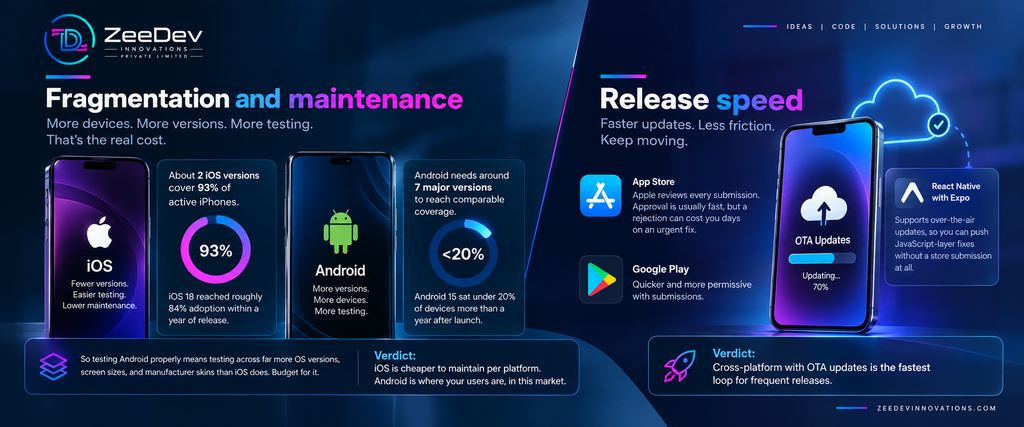
About two iOS versions cover 93% of active iPhones. iOS 18 reached roughly 84% adoption within a year of release. Android needs around seven major versions to reach comparable coverage, and Android 15 sat under 20% of devices more than a year after launch.
So testing Android properly means testing across far more OS versions, screen sizes, and manufacturer skins than iOS does. Budget for it. An Android-only build isn’t automatically cheaper than an iOS-only build once QA is priced honestly.
Verdict: iOS is cheaper to maintain per platform. Android is where your users are, in this market.
Release speed
Apple reviews every submission, and while approval is usually fast now, a rejection can cost you days on an urgent fix. Google Play is quicker and more permissive.
One advantage that doesn’t get enough attention: React Native with Expo supports over-the-air updates, so you can push JavaScript-layer fixes without a store submission at all. For a product iterating weekly, that changes the rhythm of development entirely.
Verdict: cross-platform with OTA updates is the fastest loop for frequent releases.
Store fees: less than you probably think
Most articles quote “30% to Apple” as though every app pays it. Most business apps pay nothing.
The commission applies to digital goods: paid downloads, in-app purchases, and subscriptions. It does not apply to physical goods or real-world services. A restaurant ordering app, an ecommerce app, a taxi app, a clinic booking app, a logistics app all of these process payments outside the store’s billing and pay 0% commission.
If you do sell digital goods:
- Apple Developer Program costs $99 a year. Google Play charges $25, once.
- Apple’s standard commission is 30%, dropping to 15% under the Small Business Program for developers earning under $1 million a year in proceeds. Subscriptions drop to 15% from a subscriber’s second year.
- Google Play runs 15% on the first $1 million a year, 30% above it, with 15% on subscriptions.
Both structures are in motion. The 2025 US ruling in Epic v. Apple forced Apple to allow external payment links without commission in US apps, Google settled with Epic in March 2026 and is revising its fee schedule, and the EU’s Digital Markets Act has produced a different rate structure again inside Europe. The direction is downward but the detail changes by market and by quarter, so confirm current terms for your specific markets before you model revenue. Don’t budget from an article, including this one.
Talent and hiring
React Native has the largest developer pool because it draws on the entire JavaScript and React ecosystem, and it typically costs less to hire for. Flutter’s pool has grown quickly and skews toward developers who care about UI precision. Kotlin Multiplatform is newer, adoption jumped from around 7% to 23% in roughly eighteen months, and the talent pool is thinner but rising. Senior native iOS developers are the most expensive and hardest to replace, particularly outside major tech hubs.
For a business that will eventually hand the app to an internal team or another agency, hiring reality is a legitimate selection criterion. An app nobody local can maintain is a liability with a countdown on it.
The three cross-platform options, briefly
If cross-platform is the direction, the next question is which one.
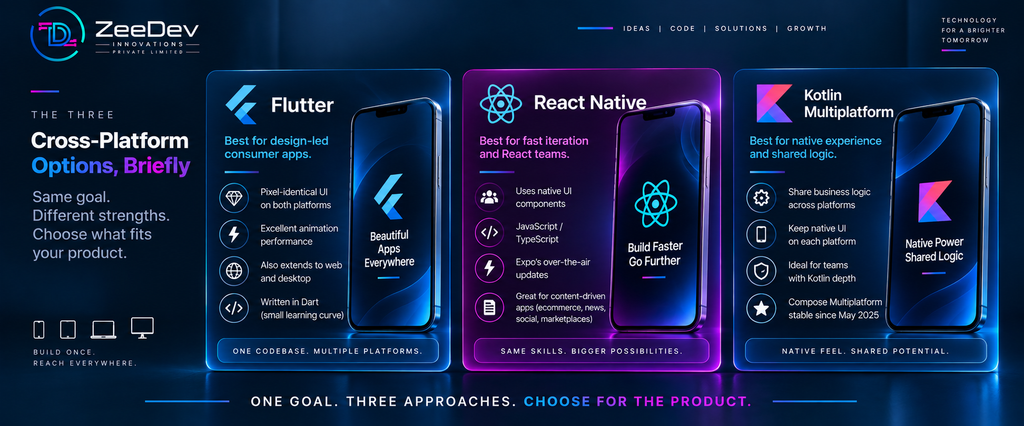
Flutter renders its own UI, which gives pixel-identical results on both platforms and excellent animation performance. Best for design-led consumer apps, and it extends to web and desktop from the same codebase. Written in Dart, which is a small learning curve rather than a real barrier.
React Native uses actual native UI components and JavaScript or TypeScript. Best when you already have React developers or a React web codebase to share logic with, and for content-driven apps: ecommerce, news, social, marketplaces. Expo’s over-the-air updates are a genuine advantage for fast iteration. It moved to the independent React Foundation in 2026, which reduces its dependence on Meta.
Kotlin Multiplatform shares business logic while keeping the UI native on each platform. Best for teams with Kotlin depth, or products where native look and feel is non-negotiable but the logic layer is substantial. Compose Multiplatform has been stable since May 2025 if you want to share UI as well.
Neither of the first two is at risk of abandonment, which is the objection we hear most often. Flutter powers Google’s own products and its desktop work is co-maintained by Canonical. React Native is used in production by Meta, Shopify, and Microsoft.
Which fits your situation
Consumer app for Pakistani users, limited budget. Flutter or React Native, Android released first. Add the iOS build once you have traction or start selling abroad.
App for US or UK customers with subscriptions. iOS first, because that’s where both the users and the paying users are. Cross-platform if you want Android in the same budget, native iOS if the experience has to be flawless for a premium audience.
Internal business tool: field staff, inventory, attendance, logistics. Cross-platform, every time. Your staff carry mixed devices, nobody is judging the animations, and one codebase means one maintenance bill.
Ecommerce app built on an existing store. React Native, usually, because it shares logic well with a web frontend and content-driven UIs are its strength. Worth confirming you need an app at all first, which the next section covers.
Camera, AR, Bluetooth, IoT, or real-time media. Native, or a hybrid: native UI shells over shared logic in Kotlin Multiplatform.
MVP to test an idea or show investors. Flutter or React Native, one platform, smallest feature set that proves the point. Build the real thing after the idea survives contact with users.
Before you choose: do you actually need an app?
The most expensive mistake in this category isn’t picking the wrong framework. It’s building an app that a mobile website would have handled.
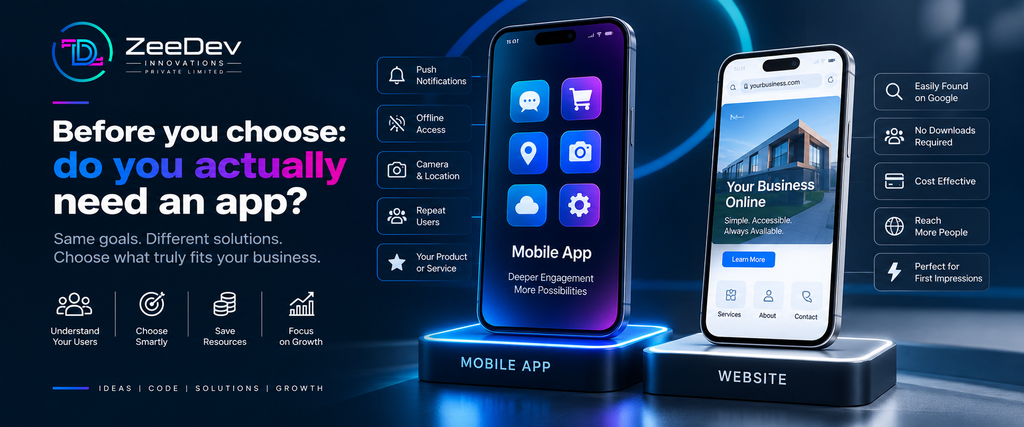
An app makes sense when you have repeat users who will open it weekly, when you need push notifications, offline use, camera or location access, or when the app itself is the product. A loyalty programme, a booking system customers use monthly, a delivery service, an internal tool.
An app does not make sense when you mostly need to be found and contacted. Nobody downloads an app to hire an interior designer once. That’s a website’s job, and we argued the broader case in why a well-developed website matters to every business.
The test we give clients: will a typical user open this more than four times in a year? If not, build a fast mobile website instead and spend the difference on getting found.
We’d rather tell you that before the invoice than after.
Mistakes we see repeatedly
Defaulting to the platform you personally carry. A Karachi founder building iOS-first for a Pakistani audience, or a US-market product built Android-first because the whole dev team uses Android.
Choosing native for an app that doesn’t need it. Paying twice for a codebase, forever, to get polish nobody asked for.
Forgetting the second year. The build is a fraction of the lifetime cost. OS updates, store policy changes, SDK deprecations, and security patches are permanent line items. Ask any agency what maintenance costs before you sign, not after.
Launching on both stores at once with no users. Two release processes, two review queues, two sets of crash reports, before you know whether anyone wants the thing.
Ignoring payments early. If the app takes money in Pakistan, JazzCash, Easypaisa, and cash-on-delivery flows need designing in from the start, not bolted on at the end. Same lesson as the platform payments problem we covered in WooCommerce vs Magento vs Shopify.
Frequently asked questions
Should I build for Android or iOS first in Pakistan? Android, for a Pakistani audience. iPhone penetration in Pakistan is below 7% while Android sits above 93%, so an iOS-first launch reaches a small fraction of the local market. Build iOS first only if your paying customers are in the US, UK, Japan, Australia, or the Gulf.
Is cross-platform development worse than native? Not for most business apps. React Native’s New Architecture and Flutter’s Impeller renderer closed the performance gap for standard interfaces. Native still leads for camera-heavy, AR, Bluetooth, gaming, and real-time media apps, and for day-one access to new OS features.
Flutter or React Native, which should I choose? React Native if you have JavaScript or React developers, or a web codebase to share logic with, and if you want over-the-air updates through Expo. Flutter if the app is design-led, needs identical UI on both platforms, or may extend to web and desktop later. Both are production-ready and actively maintained.
How much does it cost to build a mobile app? It depends on scope far more than on platform, but the structural difference is that building native for both stores costs roughly 30–40% more than one cross-platform codebase, and the gap repeats with every feature and every year of maintenance. Get quotes that separate build cost from annual maintenance, because the second number is the one that surprises people.
Do I have to pay Apple and Google 30% of my revenue? Only on digital goods: paid apps, in-app purchases, and subscriptions. Apps selling physical products or real-world services pay no commission at all. If you do sell digital goods, Apple’s Small Business Program and Google Play’s first-million tier both reduce the rate to 15%, and ongoing court rulings in the US and EU have been pushing these fees down further.
Can one app work for both Android and iOS? Yes. That’s what cross-platform frameworks do: one codebase compiled into two native apps, published to both stores. It’s how most business apps are built now, because running two separate codebases is a cost very few businesses can justify.
Our recommendation
For most businesses, build cross-platform, and pick the framework by what your team and product actually need rather than by which one won an internet argument. Flutter for design-led consumer products. React Native for content-driven apps and JavaScript teams. Kotlin Multiplatform when native UI matters but the logic layer is heavy.
Choose native when the app lives at the hardware frontier, or when a premium audience will notice the difference and you can fund two codebases indefinitely.
And choose which store first by looking at where your users are, not where you are. Android for Pakistan and most emerging markets. iOS for the US, UK, and anywhere your revenue comes from subscriptions.
ZeeDev Innovations builds mobile applications for iOS and Android from Islamabad, for clients in Pakistan, the UK, and the US including the AI Lawyer System app, which pairs AI-assisted recommendations with secure booking and real-time communication. See our portfolio or book a free consultation and we’ll tell you which approach fits your product, including whether you need an app at all.