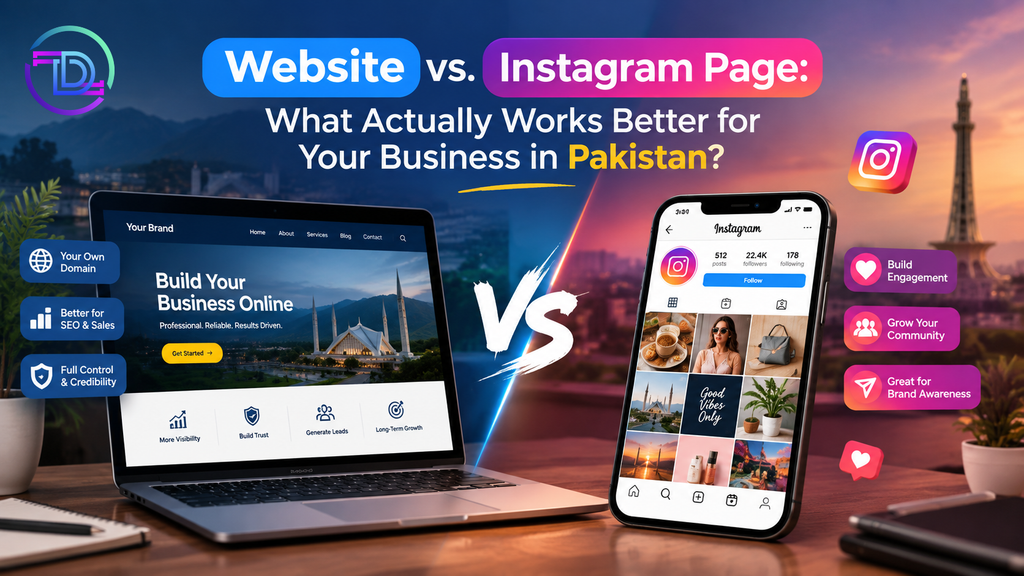
Website vs Instagram Page for Business: Which One Actually Brings You Paying Customers?
Short answer: an Instagram page gets you seen. A website gets you paid. If you sell to businesses, charge more than PKR 20,000 per order, or need someone to trust you before they hand over money, the website is the priority and Instagram is the feeder. If you sell low-cost visual products to people under 30, start on Instagram and build the site the moment repeat buyers show up.
That’s the verdict. Now here’s the part nobody tells you, with the numbers behind it.
Quick verdict: which one should you build first?
Build the website first if you:
- Sell to other businesses, exporters, factories, distributors, or government buyers
- Are a doctor, lawyer, chartered accountant, architect, consultant, or agency
- Take bookings (hotels, guest houses, clinics, salons, event venues)
- Run admissions (schools, academies, training institutes)
- Want inquiries from outside Pakistan
Build the Instagram page first if you:
- Sell something visual under PKR 10,000 (clothes, jewellery, food, cosmetics, home décor)
- Are a personal brand: trainer, photographer, makeup artist, content creator
- Have zero budget this month and need your first 10 customers this month
- Are still testing whether anyone wants the product at all
Almost nobody should stop at one. The order matters more than the choice.
Talk to our team about what your business actually needs →
Website vs Instagram page: the at-a-glance comparison
| Criteria | Business Website | Instagram Page |
|---|---|---|
| Who owns it | You. Domain, content, database, customer list | Meta. Your account exists at their discretion |
| Conversion rate | 2.0%–3.0% from organic search traffic | 0.7%–1.5% from social traffic |
| Cart abandonment | 63.8% (search traffic) | 77.5% (social traffic) |
| Buyer intent | High. They searched for what you sell | Low. They were watching Reels |
| Lifespan of one piece of content | Years. A ranking page earns daily | 24–72 hours, then it’s gone |
| Reach in Pakistan | 117 million internet users | ~24 million Instagram users |
| Cost in year one | Higher upfront, near-zero to run | Free to open, expensive to keep alive |
| Works while you sleep | Yes | Only if you posted recently |
Conversion and abandonment figures: OptiMonk’s 2026 analysis of 18,000 ecommerce sites, cross-referenced with Littledata and IRP Commerce channel benchmarks. Pakistan user counts: DataReportal (October 2025) and NapoleonCat (March 2026).
How we compared these two
We build both. ZeeDev Innovations runs web development and digital marketing out of Islamabad, and a good share of our client work involves a business that already had 5,000 or 20,000 Instagram followers and couldn’t understand why the DMs weren’t turning into orders.
So the comparison below uses four measures that actually appear on a P&L:
- Intent quality: was the person looking for you, or did they stumble on you?
- Conversion rate: what percentage of visitors become an inquiry or a sale?
- Ownership risk: what happens on the day the platform changes its mind?
- Cost of one acquired customer over 12 months, not the cost of setup
Follower count is not on that list. Follower count has never paid a salary.
The number that ends most of these arguments
Here’s where the website vs Instagram page debate stops being a matter of opinion.
Across large ecommerce datasets, traffic arriving from social platforms converts at roughly 0.7% to 1.5%. Traffic arriving from organic search converts at roughly 2.0% to 3.0%. OptiMonk’s study of 18,000 stores puts social at 0.91% and organic search at 1.55%. Broader 2026 syntheses from Littledata and IRP Commerce put organic search closer to 2.7%.
Whichever dataset you pick, the gap holds: search traffic converts two to three times better than social traffic.
It gets worse at checkout. Social traffic abandons carts at 77.5%. Search traffic abandons at 63.8%. Social traffic also bounces hardest, at 63.9%.
Why? Intent. Nobody opens Instagram to buy an industrial water pump. They open it to kill twenty minutes. The person typing “water pump supplier Lahore” into Google has a broken pump, a budget, and a deadline.
What that means in rupees
Let’s take a real shape of business: a home décor brand in Islamabad with 12,000 Instagram followers and an average order value of PKR 6,500.
Instagram-only month:
- Organic reach on a good post: about 8% of followers, so ~960 people see it
- Of those, roughly 40 tap through to the profile
- 12 send a DM asking “price?”
- 4 convert after the back-and-forth
- Revenue: PKR 26,000. Plus about 10 hours of someone’s week answering DMs and quoting prices one at a time.
Website doing 1,200 organic visits a month at 2.5%:
- 30 orders, no DM negotiation, no “price kya hai?” at 1am
- Revenue: PKR 195,000
- And those 1,200 visits happen next month too, without a single new post
That’s not a small edge. That’s a different business.
Now, the honest caveat: getting to 1,200 organic visits a month takes four to eight months of real SEO work on a properly built site. Instagram gives you those first four sales this week. That’s exactly why the sequencing question matters more than the “which is better” question.
The reach illusion: Instagram is smaller than you think
“Everyone is on Instagram.” Everyone is not.
DataReportal counted 117 million internet users in Pakistan at the end of 2025. NapoleonCat counted 24 million Instagram users in Pakistan as of March 2026, about 10.1% of the population.
So Instagram reaches roughly one in five people who are online in this country. Google reaches all of them.
The demographic skew is sharper still. 64% of Pakistani Instagram users are men, and the single largest age group is 18–24, at over 10 million users. If your buyer is a 47-year-old procurement manager in Faisalabad, a 52-year-old mother researching a school for her daughter, or a purchasing head in Dubai sourcing textiles, Instagram is not where they are. They’re in a search bar.
And the reach you do have is rented. Organic reach on Meta platforms has been sliding for a decade. Your 12,000 followers do not mean 12,000 views. On most business accounts we audit, a non-boosted post reaches between 5% and 12% of the follower count. To reach the rest, you pay.
Ownership: renting an audience vs owning one
This is the difference most business owners feel only once, and by then it’s expensive.
An Instagram page sits on Meta’s servers under Meta’s terms. Meta can change the algorithm, throttle your reach, restrict your account, or disable it entirely over a copyright flag, a mass-report campaign from a competitor, or a bot error. There is no meaningful appeal process for a small business in Pakistan. We’ve watched accounts with 40,000 followers vanish on a Tuesday.
When that happens, you lose the followers, the post history, the DM inbox, and every unanswered inquiry inside it. There is no export button for a community.
A website loses nothing in that scenario. You own the domain, the hosting, the content, the customer database, and the email list. If your host misbehaves, you move the site somewhere else in a day and keep every visitor you earned.
That’s the actual distinction between the two: one is a channel you borrow, one is an asset you hold. Assets can be sold with the business. Instagram followers cannot.
The real gaps: seven things an Instagram page cannot do
This is the section the generic “you need both!” articles skip.
1. It cannot be found by someone who doesn’t know you exist. Instagram search matches handles and hashtags. It does not answer “best ERP software company in Islamabad” or “CNC machining service Sialkot.” Google does, and those searches carry purchase intent that no Reel can manufacture.
2. It cannot hold more than a bio’s worth of information. 150 characters and a grid. Your buyer wants specifications, certifications, MOQ, lead times, warranty terms, case studies, and a downloadable catalogue. There’s no place to put any of that.
3. It cannot be verified as a real company. A website with a physical address, a landline, an SECP registration number, an NTN, and named team members reads as a business. A handle with a WhatsApp number reads as a side hustle, fairly or not. For export inquiries this decides whether your email gets answered at all.
4. It cannot measure anything useful. Instagram tells you reach, saves, and profile visits. It cannot tell you that 68% of visitors drop off on your pricing page, that mobile users abandon at checkout twice as often as desktop, or which city generated your best leads last quarter. Without that, you’re optimising blind.
5. It cannot take money properly. No structured checkout, no multiple payment options, no order confirmation email, no invoice, no automated tax handling, no abandoned cart recovery. Every sale needs a human to type out a reply.
6. It cannot compound. A Reel earns for 48 hours. A well-optimised service page earns for three years and gets stronger as it ages. Stop posting for a month and Instagram forgets you. Stop touching your website for a month and it keeps producing inquiries.
7. It cannot feed AI search. This one is new and it’s moving fast. Google’s AI Overviews, ChatGPT, and Perplexity build answers from indexable web pages. Instagram content is largely invisible to them. Businesses without a crawlable website are being left out of the answer layer that a growing share of buyers now sees first.
Which businesses need a website more than an Instagram page
Manufacturers, exporters, and industrial suppliers
Your buyer is sourcing, not scrolling. They search product terms plus a city, open six tabs, and shortlist three. Missing from that search means missing from the shortlist. You need product pages with real specifications, certifications, and a quote request form that lands in an inbox, not a DM queue. Verdict: website, non-negotiable. Instagram is optional.
Doctors, lawyers, chartered accountants, architects, consultants
Trust is the product you’re actually selling. Referrals in 2026 are passed as a link, and “Google them, they’re good” needs something credible to land on. Credentials, experience, published writing, and a booking form do that job. Motivational quote graphics do not. Verdict: website is your primary credibility asset.
Hotels, guest houses, and restaurants
Instagram sells the room. The website saves the margin. Every booking that goes through an OTA hands over 15–25% commission. A direct booking engine on your own site keeps that money. For a 20-room property, that’s a seven-figure annual difference in PKR. Verdict: the website pays for itself in one season.
Schools, academies, and training institutes
Admission decisions involve parents comparing fee structures, faculty, results, and transport routes. That research needs pages, not a grid. An inquiry form attached to a proper admissions page also gives you a lead record you can follow up on for two years. Verdict: website is the admissions engine.
Local service businesses (interior designers, electricians, clinics, movers)
A homeowner in DHA Phase 5 with a burst pipe is typing “plumber near me,” not hoping a post surfaces. Pair a website with a properly filled Google Business Profile and you show up in the map pack. Instagram cannot put you there. Verdict: the website captures active buyers. Instagram collects passive browsers.
Ecommerce sellers on Daraz or Instagram Shopping
Marketplaces rent you customers and keep the relationship. Their fees rise, their policies shift, and your brand stays invisible behind theirs. Your own WooCommerce or Shopify store gives you the customer list, the email channel, the retargeting data, and the repeat-purchase economics that make an ecommerce business worth something. Verdict: own the store, use the marketplace as a sales channel.
Startups and agencies raising money or seeking partners
Investors, enterprise clients, and distribution partners all Google you before replying. A thin web presence signals a thin company. We’ve seen deals go quiet purely because the “About” page had no team on it. Verdict: website, before the pitch deck.
Conversion rate: what actually turns a visitor into an inquiry
Building a website doesn’t earn you the 2.5%. A badly built one converts at 0.3% and everybody blames SEO. Six things move this number, in rough order of impact:
Load speed. Mobile users abandon fast. Largest Contentful Paint above 2.5 seconds costs you visitors and rankings at the same time. Most slow Pakistani business sites we audit are slow for the same two reasons: uncompressed hero images and a page builder loading fourteen plugins on every page.
One obvious next action per page. A visitor who has to decide between “call,” “WhatsApp,” “email,” “fill form,” and “download brochure” usually does none of them. Pick the action that suits the page and make it the loudest thing on it.
A WhatsApp button that pre-fills the message. In Pakistan this single element routinely outperforms contact forms by a wide margin. Pre-fill it with the page context so the conversation starts with “Hi, I’m interested in your kitchen cabinetry service” instead of “Hello.”
Proof placed next to the ask. Testimonials, client logos, project photos, review counts, registration numbers. Not stacked in a section at the bottom where nobody reaches, but sitting right beside the button you want clicked.
Price signalling. You don’t have to publish a rate card. Giving a starting range or a “typical project” figure removes the biggest silent objection and filters out the inquiries that were never going to close.
Mobile-first forms. Four fields, not eleven. Every extra field costs you completions. Name, phone, one dropdown, one message box.
Fix those six and the same traffic produces two to three times the inquiries. We’d rather rebuild a client’s conversion path before spending a rupee on ads, because ads into a leaky site just make the leak more expensive.
The cost comparison nobody runs honestly
“Instagram is free” is only true if your time is worth nothing.
| Cost item (12 months) | Instagram-only | Website + Instagram |
|---|---|---|
| Setup | PKR 0 | PKR 60,000–500,000 depending on scope |
| Domain + hosting | PKR 0 | PKR 15,000–45,000 |
| Content production | 6–10 hrs/week | 2–4 hrs/week |
| Boosted posts / ads to stay visible | PKR 10,000–50,000/month | Optional, and converts better |
| Maintenance | PKR 0 | PKR 0–10,000/month |
| Asset value at end of year | Zero. Nothing transferable | A ranking, sellable asset |
Run that over three years and the “free” option is usually the more expensive one, because visibility on Instagram has to be re-purchased every single month. Search rankings are bought once and maintained cheaply.
(Ranges reflect typical quotes in the Pakistani market and vary with scope. Get a scoped estimate for your project.)
You have an Instagram page and no website. What now?
A 90-day sequence that doesn’t require you to stop what’s working:
Days 1–30. Register the domain matching your brand name before someone else does. Get a Google Business Profile verified with real photos, hours, and service areas. Free, and it starts producing map-pack calls within weeks.
Days 31–60. Build the site. Not a 40-page monster. Home, one page per service, about with real faces, portfolio or case studies, contact. Fast, mobile-first, with a WhatsApp CTA on every page. If you sell products, add WooCommerce with a payment gateway that works locally.
Days 61–90. Point everything inward. Bio link, Story links, Reel captions, WhatsApp Business catalogue. Start publishing one genuinely useful page a month targeting a question your customers actually ask. Track inquiries by source so you can see which channel earns its keep.
Then keep posting on Instagram. It’s a good shop window. It just isn’t a shop.
Frequently asked questions
Can an Instagram page rank on Google? Barely. Your profile may appear for a branded search of your exact business name. Individual posts almost never rank for the commercial searches that bring buyers, and Instagram content is largely inaccessible to AI search tools. A website is the only reliable way to appear for “what you sell + where you sell it.”
Is a website still worth it in 2026 when everyone is on social media? Yes, and more than before. Search traffic converts two to three times better than social traffic, and AI answer engines pull from indexable web pages. Businesses without a crawlable site are being omitted from the answers buyers now read first.
How much does a business website cost in Pakistan? A credible small-business site typically runs between PKR 60,000 and PKR 500,000 depending on page count, custom design, and whether ecommerce is involved. Domain and hosting add roughly PKR 15,000 to 45,000 a year. The cheaper end is fine for a service business; ecommerce and booking systems sit higher.
Can I run a serious ecommerce business on Instagram alone? For a small volume, yes. Past roughly 30 orders a month, manual DM order-taking becomes the bottleneck: no cart recovery, no order tracking, no customer database, no email retargeting. Every one of those is worth more than the website costs.
Should I delete my Instagram once the website is live? No. Instagram is excellent at the top of the funnel. The change is directional: every post, bio, and Story should push people toward a page you control, rather than trapping them in an app you don’t.
Which converts better, WhatsApp or a contact form? In Pakistan, a pre-filled WhatsApp button usually wins on volume, while forms produce better-qualified leads for higher-value B2B work. Run both, tag the source, and after 60 days the data tells you which to feature.
The final recommendation
Instagram earns attention. Your website converts it, records it, and keeps it. One resets to zero every time the algorithm shifts. The other gets more valuable every month you leave it standing.
If you’ve spent two years building a following and still chase inquiries one DM at a time, you don’t have a marketing problem. You have a missing asset.
ZeeDev Innovations builds fast, search-optimised websites and web applications for businesses in Islamabad, across Pakistan, and internationally from ecommerce stores to custom software and booking systems. Look through our recent projects, see what we build, or book a free consultation and we’ll tell you honestly whether you need a website yet.