Web Development: Why a Well-Developed Website Matters to Every Business
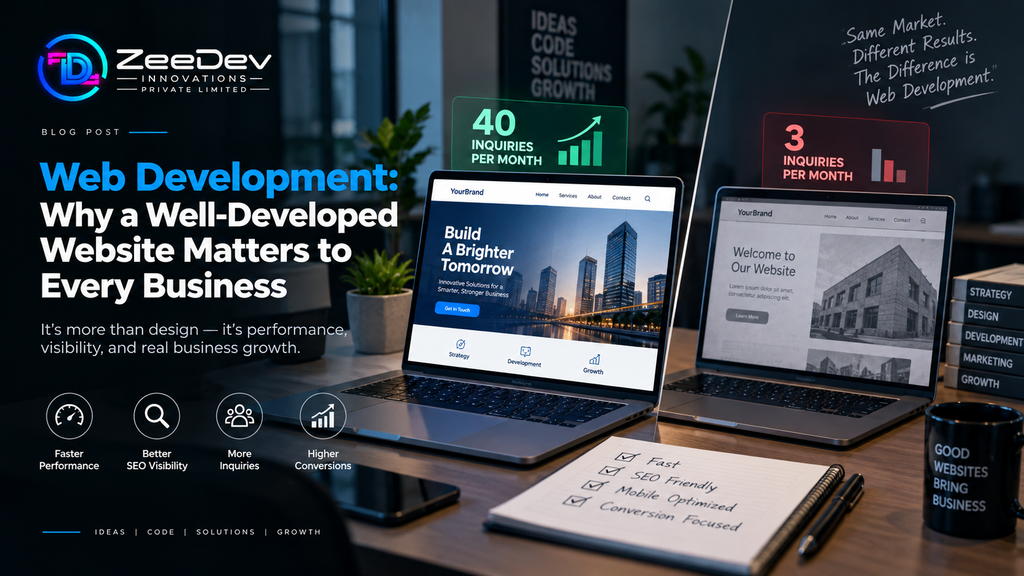
Two businesses in the same market both have a website. One gets 40 inquiries a month from Google. The other gets three and blames the economy.
The difference is almost never the logo. It’s web development: what’s underneath the design, how fast it renders on a mid-range Android phone on a patchy 4G connection, whether Google can read it, and whether the path from “landed on the page” to “sent an inquiry” has any friction in it.
Most articles on this topic will tell you a website builds credibility and reaches customers 24/7. True, and useless, because it doesn’t tell you what separates a site that earns from a site that just exists. This one does, with the numbers attached.
“Has a website” and “has a well-developed website” are different line items
Here’s the fastest way to see the gap.
The average website loads in about 3.2 seconds on desktop and 8.6 seconds on mobile. Google’s own research found that 53% of mobile visits are abandoned when a page takes longer than 3 seconds. Portent’s analysis of load time against sales put conversion at 3.05% for a page loading in 1 second, and 0.41% at 5 seconds.
Read that last pair again. Same product, same price, same traffic. Seven times the revenue, decided by engineering.
Only 42% of mobile sites pass all three of Google’s Core Web Vitals, against 63% on desktop. So the majority of business websites in existence are sitting on the wrong side of that number right now, quietly leaking money their owners never see on a dashboard because the visitor left before analytics could fire properly.
A well-developed website is not a prettier version of a bad one. It’s a different machine.
Get your current site audited by our team →
What “well-developed” actually means, in things you can measure
Design is subjective. Development is not. These seven things are testable this afternoon, and each one has a direct business consequence.
1. It renders fast on the device your customers actually use
Mobile carries roughly 62% of ecommerce traffic and converts at about half the rate of desktop, near 2% against 4%. That gap is partly behavioural and largely technical: heavy hero images, render-blocking scripts, and slow server response.
Google’s thresholds, measured on real visitors at the 75th percentile:
| Metric | Good | Needs work | Poor |
|---|---|---|---|
| LCP (main content visible) | ≤ 2.5s | 2.5–4.0s | > 4.0s |
| INP (response to taps and clicks) | ≤ 200ms | 200–500ms | > 500ms |
| CLS (layout stability) | ≤ 0.1 | 0.1–0.25 | > 0.25 |
One red metric fails the whole page. There’s no averaging.
The business case is documented in controlled tests, not theory. Vodafone Italy A/B tested two pages that were visually identical, one with a 31% better LCP; the faster page produced 8% more sales. Rakuten 24 passed all three Core Web Vitals and recorded a 33.1% higher conversion rate and 53.4% more revenue per visitor. Renault measured a 1-second LCP improvement as a 13% lift in conversions.
And the failure is almost always the same two things: uncompressed images and too many scripts. A 2.4 MB hero photo that should have been a 180 KB WebP. Converting images properly improves LCP by 30–50% on its own, which is why it’s the first thing we touch on any rebuild.
2. It’s built so search engines can read it
A site can look finished and still be structurally invisible. Proper development means a clean heading hierarchy, one H1 per page, crawlable internal links (not JavaScript-only navigation), an XML sitemap that reflects reality, canonical tags on duplicated content, and schema markup that tells Google what kind of thing each page is.
Schema is the one most small-business sites skip, and it’s the one producing visible gains now. LocalBusiness schema with your real address and hours. Product schema with price and stock. FAQ markup. Review markup. These decide whether you appear as a plain blue link or a result with stars, prices, and answers attached.
There’s a newer reason to care. Google’s AI Overviews, ChatGPT, and Perplexity build answers from structured, crawlable pages. If your content sits inside a JavaScript widget or a PDF, you’re not in that answer layer. Businesses are already losing clicks they never knew existed.
3. It works when the person using it can’t use a mouse
Accessibility gets treated as a compliance chore. In practice it’s a conversion feature and an SEO feature. Sufficient colour contrast, labelled form fields, alt text, keyboard navigation, and logical heading order help screen readers and search crawlers read your page the same way.
Also: about one in twelve men has some form of colour vision deficiency. If your “Order Now” button relies on red-green contrast alone, a slice of your buyers can’t find it.
4. It’s secure enough that you don’t lose the whole thing on a Tuesday
SSL, a hardened login, updated core and plugins, daily off-site backups, and a firewall. WordPress sites don’t usually get hacked through some elegant zero-day. They get hacked through an abandoned plugin last updated in 2021 that somebody installed once to add a countdown timer.
We’ve been handed sites where fixing the security debt cost more than the original build. Recovering from a defaced homepage during your peak season costs more still, and Google will flag you in the results while it’s happening.
5. It can be changed without calling a developer every time
A business changes. Prices, services, team, locations, offers. If every small edit needs a dev ticket, the site goes stale, and a stale site stops ranking.
Good development means the content that changes often lives in editable fields, not hardcoded in a template. Your team updates the price list. Your developer handles the structural work. That split is a build decision, made on day one or not at all.
6. It’s instrumented, so you know what’s broken
Google Analytics 4 with conversion events on every form, call, and WhatsApp click. Search Console verified. Heatmaps if the budget allows.
Without this you’re guessing. With it you find out that 68% of visitors drop off at the pricing section, that your contact form throws a silent error on iOS, or that half your traffic comes from a city you never targeted. Every site we’ve audited has had at least one of these, and the fix is usually an afternoon’s work that pays for itself in a week.
7. The path from visit to inquiry has no friction in it
The single most common thing we fix: a beautiful website with no obvious next step. Five competing calls to action, a contact form with eleven fields, a phone number nobody made clickable on mobile.
What works, consistently, in this market:
- One primary action per page, visually louder than everything else
- A WhatsApp button that pre-fills the message with the page context, so the chat opens with “Hi, I’m interested in your kitchen cabinetry” instead of “Hello”
- Four-field forms: name, phone, one dropdown, one message box
- Proof sitting next to the ask, not buried in a section at the bottom
- Some price signal, even a range, so the visitor stops wondering
The business case, stated properly
Now for the benefits everybody lists, with the part they leave out.
Ownership. Your domain, your content, your customer database, your email list. A social media following is rented from a company that can restrict or delete it without explanation. We covered that trade-off in detail in website vs Instagram page for business. A website is also the only part of your digital presence that can be valued and sold with the business.
Credibility, which is mostly technical. People decide whether to trust a company within seconds of landing, and most of what they’re reacting to is build quality: does it load, does it fit the screen, is the SSL padlock there, is the layout jumping around while they read. A broken certificate warning ends the visit before your copy gets a chance.
Lower cost per lead over time. Ads stop the moment you stop paying. A service page that ranks keeps producing inquiries at effectively zero marginal cost, and gets stronger as it ages. Most of our clients start with paid traffic and shift the mix over the first year as organic pages start carrying weight. The build cost amortises; the ad spend never does.
Fewer repetitive conversations. Specifications, pricing ranges, delivery areas, policies, timelines. Every question answered properly on the site is a question your team stops answering by phone twelve times a week. For a small operation that’s hours back, weekly.
It works while you sleep. An order that comes in at 2am, a booking from a buyer in a different time zone, a quote request from Dubai on a Sunday. Nobody had to be awake. This is the part that matters most for exporters and for anyone selling outside Pakistan.
A destination for every other channel. Instagram, email, Google Business Profile, print, a WhatsApp broadcast. They all need somewhere to send people that you control and can measure. Without it, every campaign’s results disappear into a DM inbox.
Run this audit on your own site in ten minutes
No tools to buy. Do it now, on your phone.
- PageSpeed Insights. Enter your URL. Look at Field Data (real visitors), not the lab score. Any red metric is costing you money today.
- Open your homepage on mobile data, not WiFi. Count the seconds until you can read something. Past three, you’re losing half your visitors.
- Tap your phone number. Does it dial? If not, that’s a broken conversion path on the most common action there is.
- Search
site:yourdomain.comon Google. Fewer pages listed than you have? Google isn’t indexing you properly. - Check the padlock. No SSL, or a warning, means Chrome is actively telling visitors to leave.
- Read your homepage title tag (the browser tab text). If it says “Home” or “Untitled”, you’ve given away your most valuable SEO real estate.
- Count the fields in your contact form. More than five is costing you completions.
- Check the copyright year in your footer. If it’s two years old, so is everything else, and visitors notice.
Three or more failures means the site is working against you, not for you. That’s a rebuild conversation, not a patch.
Which businesses feel this most
Every business, but not equally.
Manufacturers and exporters. Your buyers search product terms and shortlist from page one. Without indexed product pages carrying specifications and certifications, you’re not in the shortlist. The website is the sales channel.
Professionals and consultants. Doctors, lawyers, chartered accountants, architects. Referrals get passed as links. What that link opens decides whether the referral converts.
Hotels, restaurants, clinics. Direct bookings keep the 15–25% you’d otherwise hand to a booking platform. That margin alone usually pays for the build in one season.
Ecommerce. Every 100ms of load time costs roughly 1% in conversions, and cart abandonment climbs steeply with delay. On a store doing decent volume, performance work is one of the highest-return line items available.
Schools and institutes. Admission decisions involve comparison across fees, faculty, results, and transport. That research needs structured pages and an inquiry form that creates a record you can follow up for two years.
How we build at ZeeDev Innovations
We work in six stages, and none of them get skipped for schedule.
Requirements first: goals, audience, branding, and the stakeholders who need to sign off. Then a written plan with technical specifications, so nothing runs on assumption. Design comes next as clickable prototypes for desktop, tablet, and mobile, reviewed before a line of production code. Development follows in Agile sprints, with scalability and third-party integrations factored in from the start rather than bolted on. Each sprint gets manually tested and regression-checked before release. Then maintenance: bi-weekly backups, security audits, and periodic upgrades.
That last stage is the one most businesses decline and later regret. A website is not a delivery. It’s a system that needs someone watching it.
You can see the output in our portfolio — ecommerce builds like Ardal Zaafaran and BayBargain, restaurant and reservation sites like Restaurante Miro, and custom applications where an off-the-shelf theme was never going to work.
Frequently asked questions
What’s the difference between web design and web development? Design decides what the site looks like and how a visitor moves through it. Development builds the thing that works: the code, the CMS, the database, the integrations, the performance, the security. A beautiful design on weak development produces a slow site that doesn’t rank. Strong development behind a dated design produces a fast site nobody trusts. You need both, and they’re separate skills.
How fast should my website load in 2026? Largest Contentful Paint under 2.5 seconds, Interaction to Next Paint under 200 milliseconds, Cumulative Layout Shift under 0.1, measured on real mobile visitors at the 75th percentile. Past 3 seconds on mobile, roughly half your visitors leave before seeing anything.
Is WordPress good enough for a serious business website? Yes, when it’s built properly. WordPress powers a large share of the commercial web including major ecommerce stores. Its bad reputation for speed comes from implementation: bloated themes, twenty overlapping plugins, uncompressed images, and cheap shared hosting. A well-built WordPress or WooCommerce site passes Core Web Vitals comfortably.
Should I rebuild my site or just redesign it? If the foundation is sound, meaning it’s fast, indexed, secure, and editable, a redesign is enough. If it fails three or more checks in the audit above, or if it’s on an abandoned theme with no update path, rebuilding costs less than the years of patching. We’ll tell you honestly which one you’re looking at.
How long does a professional website take to build? A focused business site typically runs four to eight weeks from requirements to launch. Ecommerce, booking systems, and custom applications run longer. Anyone quoting you three days is selling a template with your logo dropped on it.
The part worth remembering
Nobody sees your web development. They see a page that appeared instantly, a button that responded, a form that worked, and a company that felt worth trusting with money. All of that is engineering, and every second of it is measurable.
If your site is slow, unindexed, or producing silence where inquiries should be, the problem is fixable and usually cheaper than you think.
ZeeDev Innovations builds fast, search-ready websites, ecommerce stores, and custom web applications from Islamabad for clients across Pakistan, the UK, and the US. See what we build, look through our recent work, or book a free consultation and we’ll run the audit above on your site and tell you exactly what’s costing you traffic.